- Designer: Johan Benvenuto
- Artist: Maeva Da Silva
- Publisher: Libellud
- Players: 1-4 Players
- Playtime: 30 minutes
- Ages: 10+
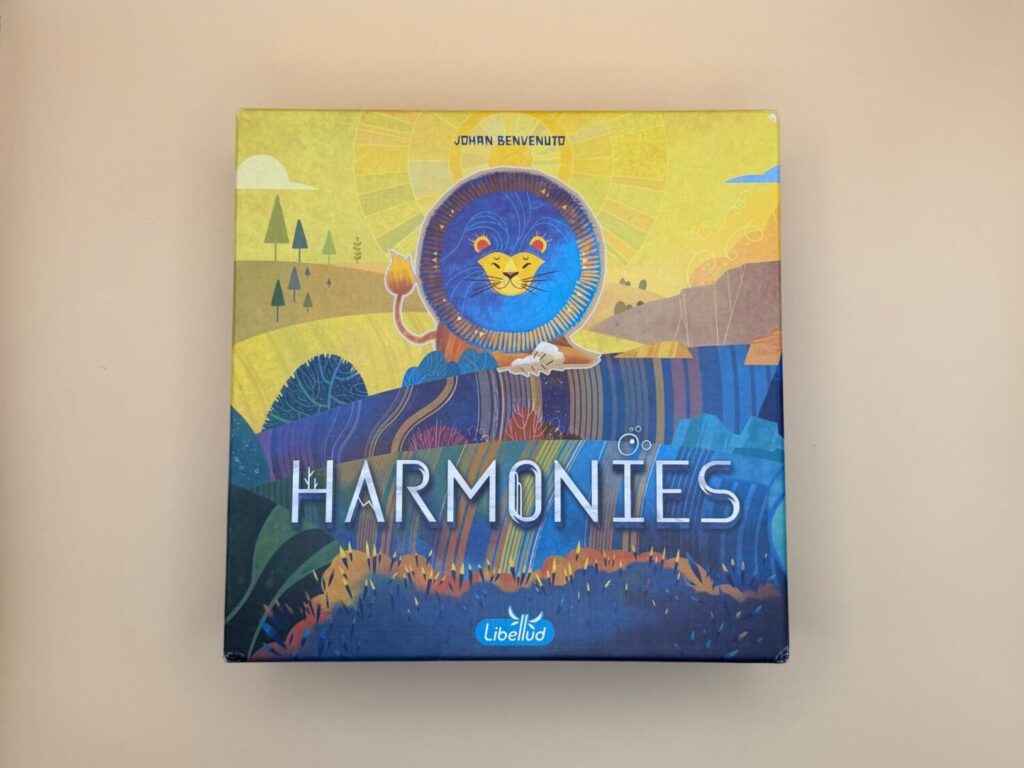
Harmonies is a game from Libellud designed for 1-4 players, ages 10+ that plays in around 30 minutes. I was first shown Harmonies through tabletop gaming social media posts. The artistic lion on the cover of the box drew me in. The premise of Harmonies is to build a diverse landscape in front of you to attract animals. Players score points on the placements of their landscape and how many animals have joined. I personally enjoy habitat building games and hoped that Harmonies would live up to the hype!
What’s In the Box?
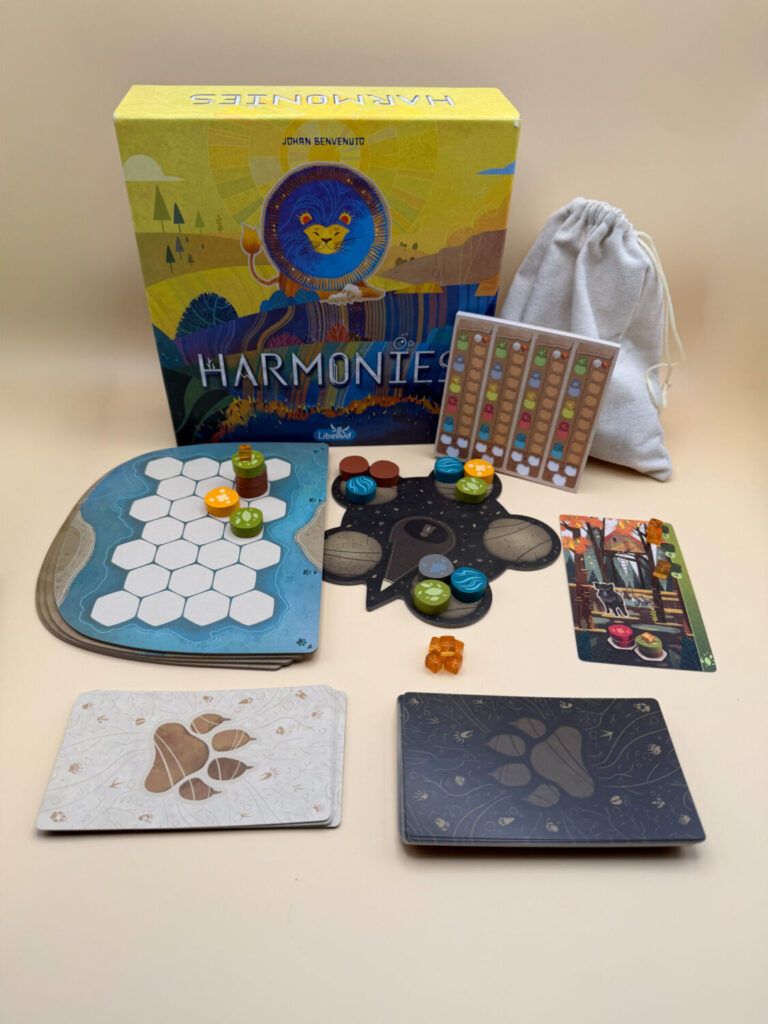
- 1 Pouch
- 1 Central Board
- 4 Personal Boards
- 4 Reminder Cards
- 120 Tokens
- 75 Animal Cubes
- 4 Nature Spirit Cubes
- 32 Animal Cards
- 10 Nature’s Spirit Cards
- 1 Scoresheet Pad
- 1 Rulebook
Setup
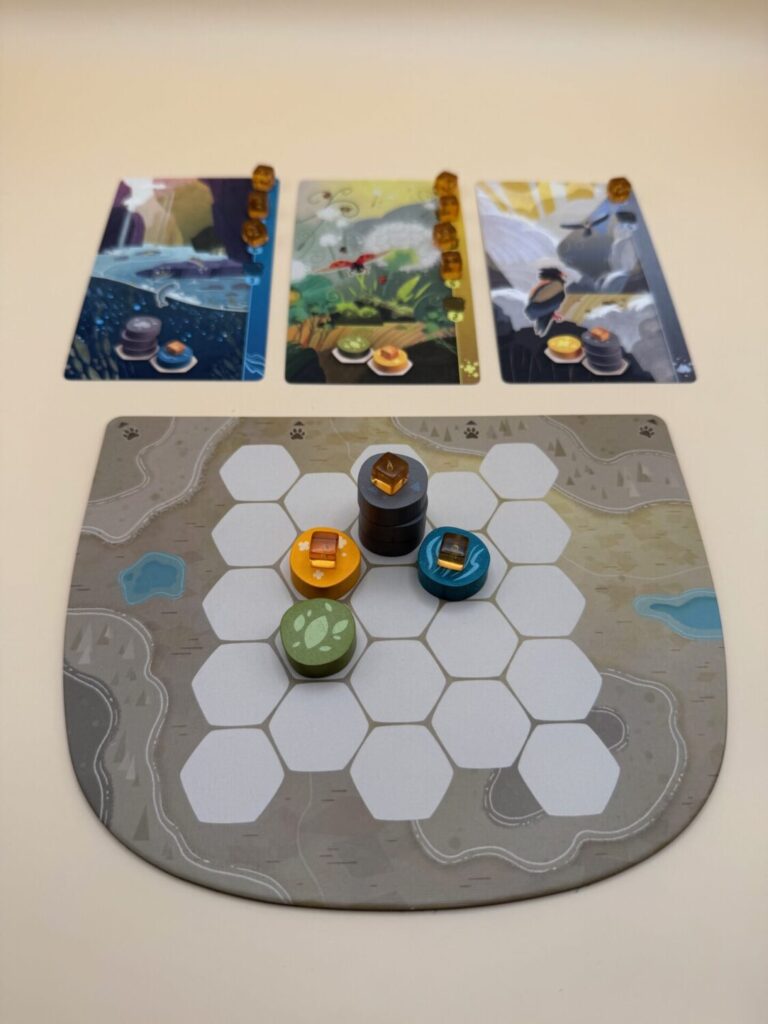
To set up Harmonies, start by putting the Central Board in the center of the playing area. Place all Tokens inside the Pouch and place the Pouch next to the Central Board. Fill each of the 5 spaces on the Central Board with 3 Tokens from the Pouch. These Tokens should be drawn at random. A player will shuffle all Animal Cards together and deal 5 Animal Cards face up next to the Central Board. The rest of the cards will be nearby, forming a draw pile. Animal Cubes should be placed in the central play area. (As it was our first time playing Harmonies, we opted out of using the Nature’s Spirit Cubes and Cards, as suggested by the Rulebook.) Each player will take a Personal Board and make sure they are all face up on the same side (blue/Side A or brown/Side B). Ensure every player also has a Reminder Card that should be showing the same side as the Personal Board. The Rulebook suggests the player who has last seen a “magnificent landscape” go first. You will make sure the arrow on the Central Board is facing the active player. You are now ready to play Harmonies!
Objective
In Harmonies, players are aiming to create the best/most diverse landscape to support the most amount of animals within that landscape. Points are calculated differently depending on what side of the Player Board you are using during the game. Follow your Reminder Card closely for how to earn points in the game.
Gameplay
There are different parts to a turn in Harmonies. The first part is mandatory. Players MUST take 3 Tokens from a spot on the Central Board and place them on their Player Board. The Tokens represent trees, mountains, fields, buildings and water. Players should use their Reminder Card for tips on how to earn the maximum amount of points. The second part is optional. Players MAY take an Animal Card and/or place 1 Animal Cube on their Personal Board. At the end of a players turn, they will draw 3 Tokens randomly from the Pouch and place on the empty spot on the Central Board. Play continues clockwise.
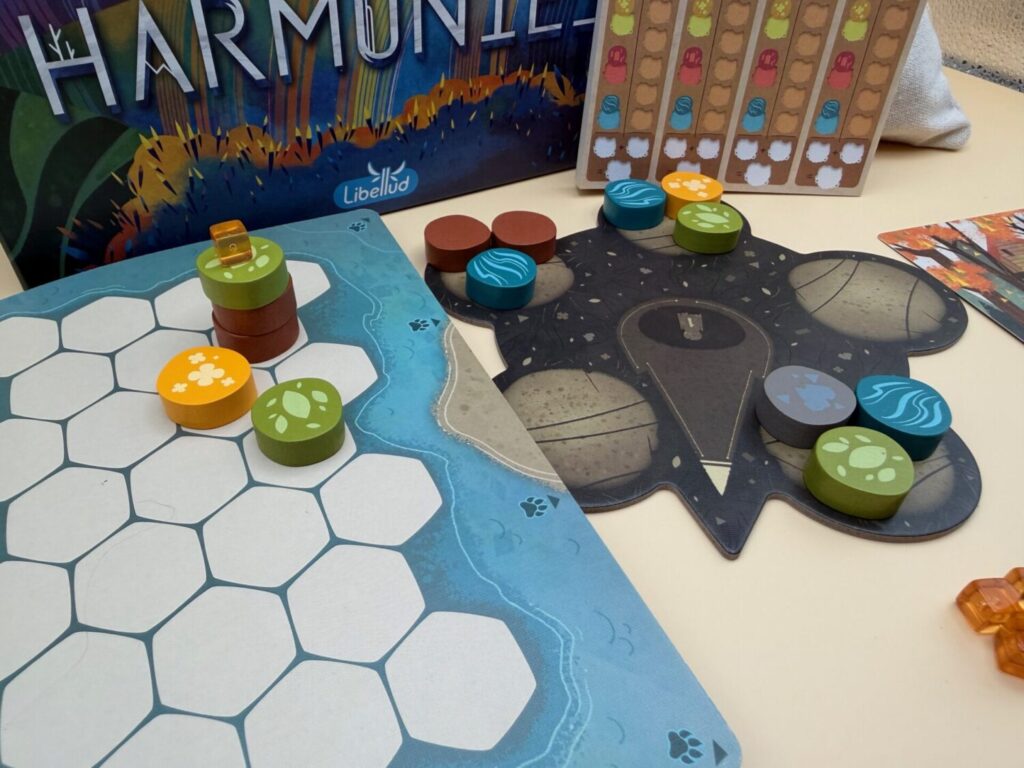
Play continues until either A) the pouch is empty when you need to refill the Central Board or B) at the end of a player’s turn there are 2 or less unoccupied spaces on their Personal Board. At this time, use the Scoresheet Pad to calculate each player’s points. The player with the most points wins! If there is still a tie, the player with the most Animal Cubes wins. If there is still a tie, players share the victory!
Final Thoughts
Harmonies is an excellent tile placement game that keeps players on their toes. In order to place the animal cubes, a player’s tiles need to match the configuration on the Animal Cards exactly at the time of placing the Animal Cubes. You can add to your landscape, but cannot take away or make changes after the Tokens are placed. Keep an eye on your current Animal Cards, as well as the ones face up about the Central Board to help plan next moves. If player’s are focused, we found it to play in the 30 recommended minutes. I agree with the ages recommendations of 10+, as there are some more complex moves that can be done and several ways to keep track of scoring points. We had our first play through with 3 players, but the game appears to scale easily for 2-4 players with the ruleset outlined above. There is a solo option for Harmonies, however, I have not yet experienced this. Harmonies calls to memory the game Azul, as you are drafting tiles and placing on a player board. Given the Azul scales well for 1 player, I would expect the same from Harmonies.
While new to Harmonies, I expect this to be a game we pull of frequently, as it is especially approachable for newer players. I look forward to playing with 4 players in the future! The artwork is beautiful, adding to the engagement of the game. I am excited that Harmonies lived up to the hype for us!
Have you played Harmonies yet? What about other habitat building games?
This post may contain affiliate links. If you click through and make a purchase, we may earn a small commission at no extra cost to you. Some products may have also been gifted for review purposes. We only recommend products we love and believe will add value to your experience. Read more on our Business Conduct Page. Thank you for supporting our blog!