- Designer: Charles Chevallier & Laurant Escoffier
- Artist: Naiade
- Publisher: Gigamic
- Players: 2-4 Players
- Playtime: 35 minutes
- Ages: 10+
Looot is a game I saw a lot on Instagram before I picked it up. I loved the Viking theme right away, but it seemed too similar to a few other resource management games I have played. After seeing quite a few reviews on it, however, I knew I had to try it out. Let’s jump into Looot!
What’s In the Box?
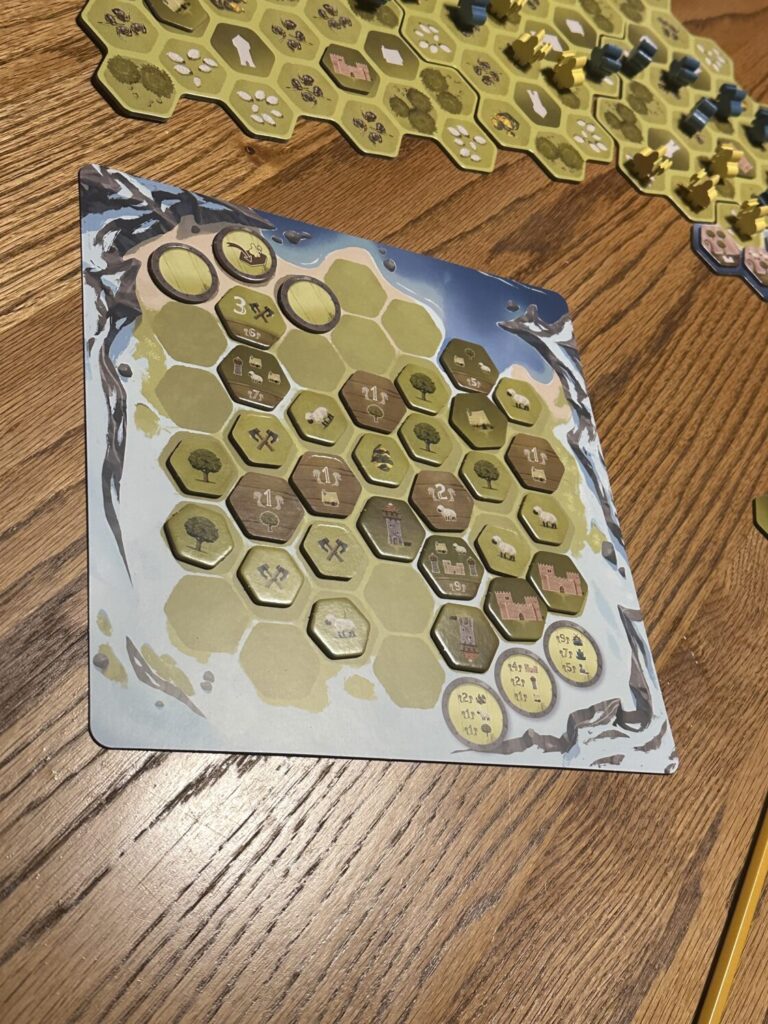
- 4 Landscape Boards
- 52 Vikings (13 of each color)
- 5 Trophies
- 43 Building Tiles
- 12 Shields
- 15 Construction Site Tiles
- 1 Trophy Board
- 90 Resources Tiles (axes, wood, sheep, and gold)
- 1 Scorepad
- 4 Fjord Boards
- 1 Ocean Board
- 1 Bag
- 30 Longships (6 wood, 6 sheep, 4 gold, 5 houses, 5 watchtowers, 4 castles)
Setup
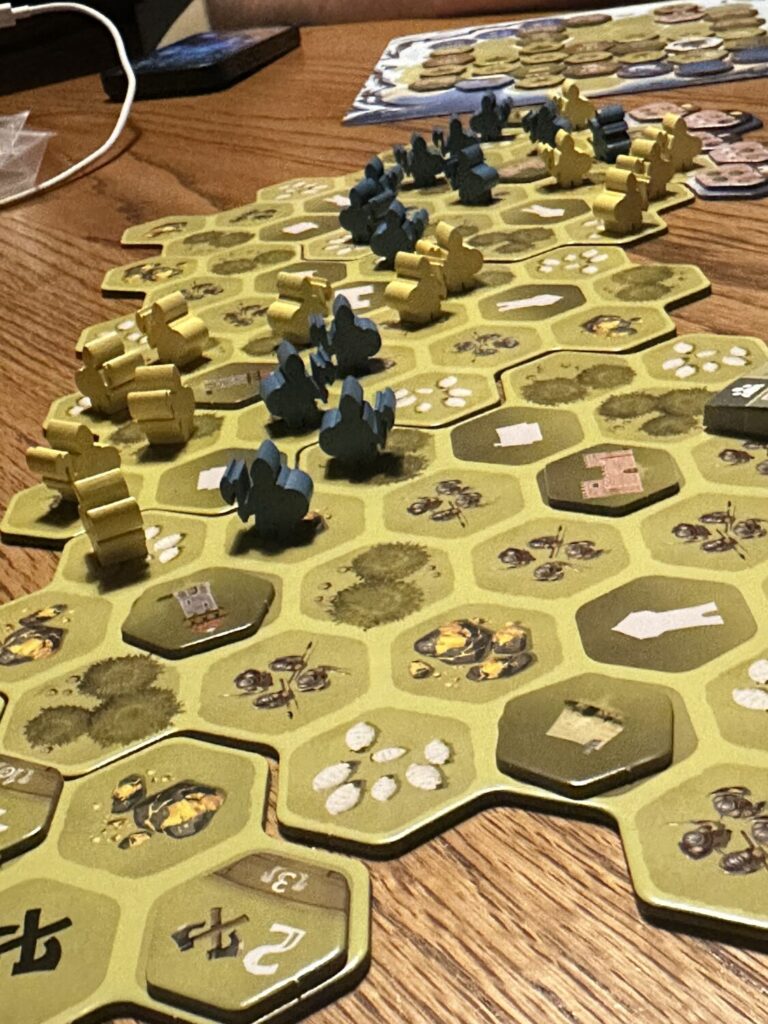
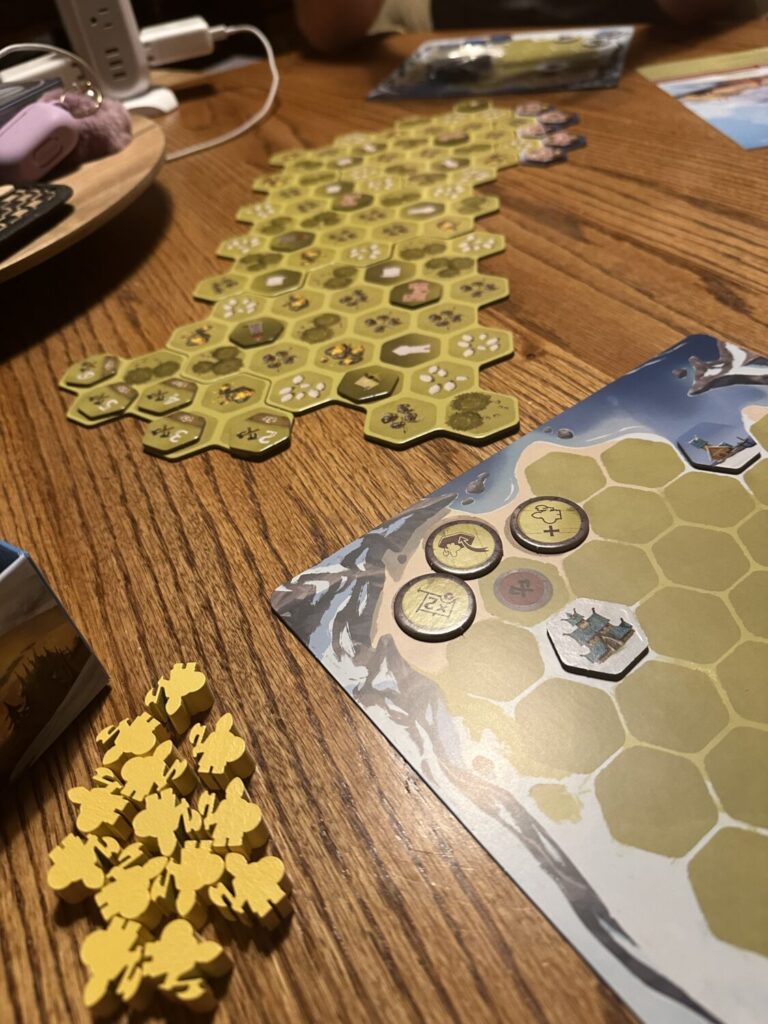
To set up Looot, you will first make the game board out of however many landscape boards there are people playing (2-4). After you place the landscape boards, place 2 houses, 2 watchtowers and 3 castles onto the matching spaces on the boards. The trophy board will go along one edge of the game board and the ocean board will go along another. Place the 5 trophies on the trophy board in numerical order. Put 30 longships in the bag and mix them up. Then take 5 out of the bag at random and place them on the ocean board.
You will place all resource tiles in one area of the table and choose a color to play (red, blue, yellow or gray). Take the components of that color: 1 Fjord board, 13 Vikings and 3 shields. Then shuffle each type of construction type and give each player a random tile of each type: ports, alters, and Jarl palaces. You are now ready to play Looot!
Objective
The objective of Looot is to earn the most points. To do this, players will gather resources and capture buildings in order to fill up their fjord board. Players will also take longship tokens, fill them, and complete their construction sites to earn more victory points. The player with the most victory points at the end of the game is the Jarl of the Vikings!
Gameplay
Per the rules, the player who lives furthest north goes first. Players take turns until they run out of Vikings. On a payers turn, they take one or more actions: placing a Viking (mandatory), capturing a building and/or completing a construction site (conditional), selecting a longship, using a shield and/or claiming a trophy (optional).
When placing a Viking, it cannot be placed on a resource space that had another Viking on it and it must be adjacent to another Viking of any color or a longship. After you place your Viking, you may take the correct resource tile and place it on an empty space on your Fjord board. This tile cannot be moved after it is placed.
Each building has different capture rules, in which a player must meet certain conditions. A player may capture a house by placing a Viking adjacent to the House on the landscape board. To capture a watchtower, a player must connect two watchtowers with a line of their colored vikings. If a player has chained together at least 4 Vikings and it is adjacent to a castle, the player captures the castle. A player may capture more than one building at a time. Once a building is captured, a player will place it on an empty spot on their Fjord board. This tile cannot be moved after it is placed in the Fjord.
To select a longship, players will take one longship from the ocean board and put it on their Fjord. To fill a longship, players must place their corresponding resources listed on the longship tile, adjacent to the longship. Once filled, the longship tile can be flipped over, revealing a bonus for victory points at the end of the game. Note: After a longship is taken off of the ocean board, another will replace it at random from the bag.
Using a shield is another option on a player’s turn. Each player has 3 that may be used once during the game. They allow a player to: place a second Viking, place a Viking in a space occupied by another viking, or take 2 of a resource instead of one when placing a Viking.
As players gain resources and buildings, they should be placing them around their construction sites in order to build them. If all resources and buildings are accounted for, a player may flip a construction site tile. This adds victory points for the player at the end of the game.
A player may claim a trophy at the end of their turn. Player’s may only claim one trophy during the game. In oder to claim a trophy, a player must have at least the number of axes shown on their trophy in their Fjord.
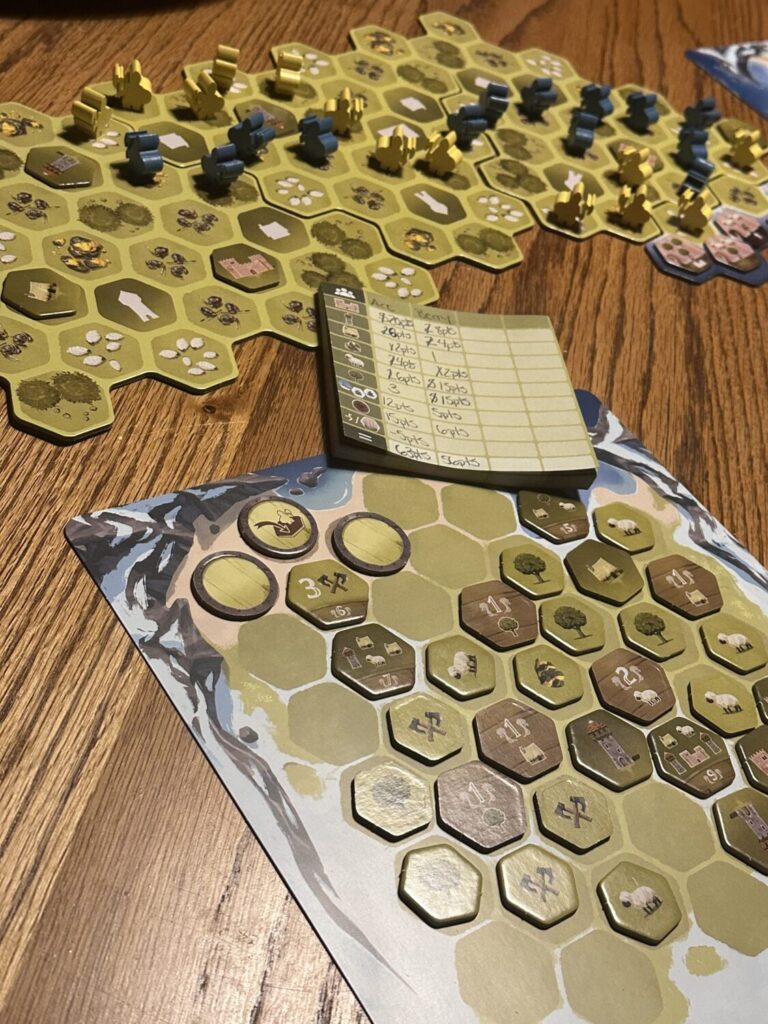
The game ends after each player has placed all 13 of their Vikings. Use the score pad to add up victory points. The player with the most points is crowned the Jarl of the Vikings! In the event of a tie, the player with the rightmost trophy value wins.
“It is hard to predict what the other players will prioritize, meaning each turn felt fresh.”
Final Thoughts
Looot was a lot of components to punch out a first, and while doing so I doubted if the game would play in 35 minutes or less. I was, however, pleasantly surprised to find that once we got going Arc and I had a rather quick play through. I enjoyed that there were many different ways to strategize in the game and that you had to be very aware of what the other player was doing in order to make the best choices. It is hard to predict what the other players will prioritize, meaning each turn felt fresh. We both agreed that it played like a quicker variation to Catan and enjoyed the Viking theme. I think the age range of 10+ on Looot is quite fair. I can’t imagine younger players finding this one approachable. It played smoothly overall, and we are both looking forward to teaching Izzie real soon!
This post may contain affiliate links. If you click through and make a purchase, we may earn a small commission at no extra cost to you. Some products may have also been gifted for review purposes. We only recommend products we love and believe will add value to your experience. Read more on our Business Conduct Page. Thank you for supporting our blog!