- Designer: Klaus-Jurgen Wrede
- Players: 2-5
- Playtime: 35 minutes
- Ages: 7+
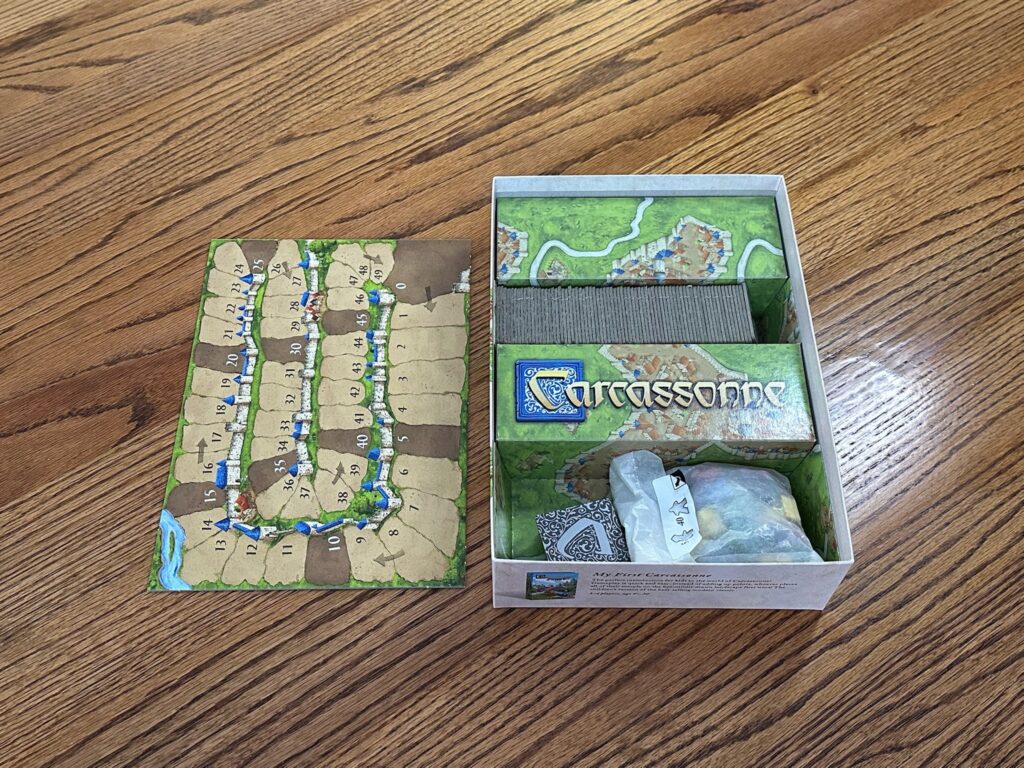
Carcassonne by Z-Man Games is designed by Klaus-Jurgen Wrede and was first published in 2000. It is a light weight tile placement game for 2-5 players, ages 7+ and plays in about 35 minutes. In the base game, players work together to build out a landscape consisting of cities, towns, roads and monasteries in Southern France.
What’s In the Box?
Carcassonne includes 84 Land Tiles to create the landscape, picturing roads, cities and monasteries. There are 40 Meeples, 8 of each color and a Scoreboard. Additionally, in our Carcassonne box there are 12 River Tiles and 5 Abbot Meeples. These additional components are used for the expansions.
Setup
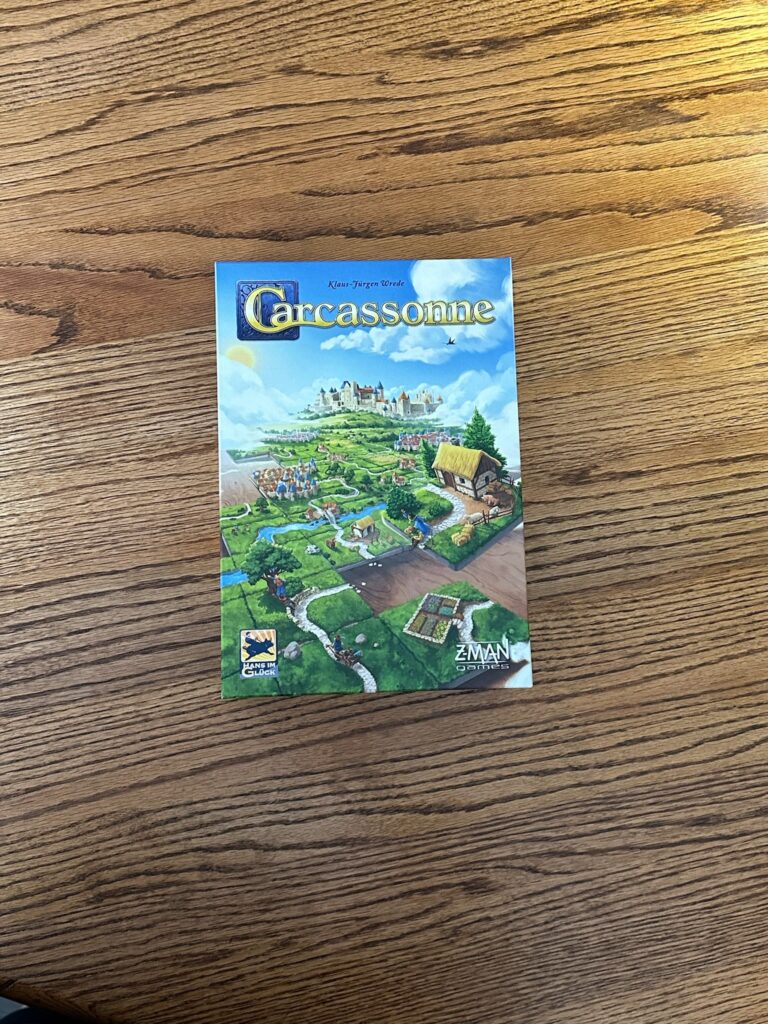
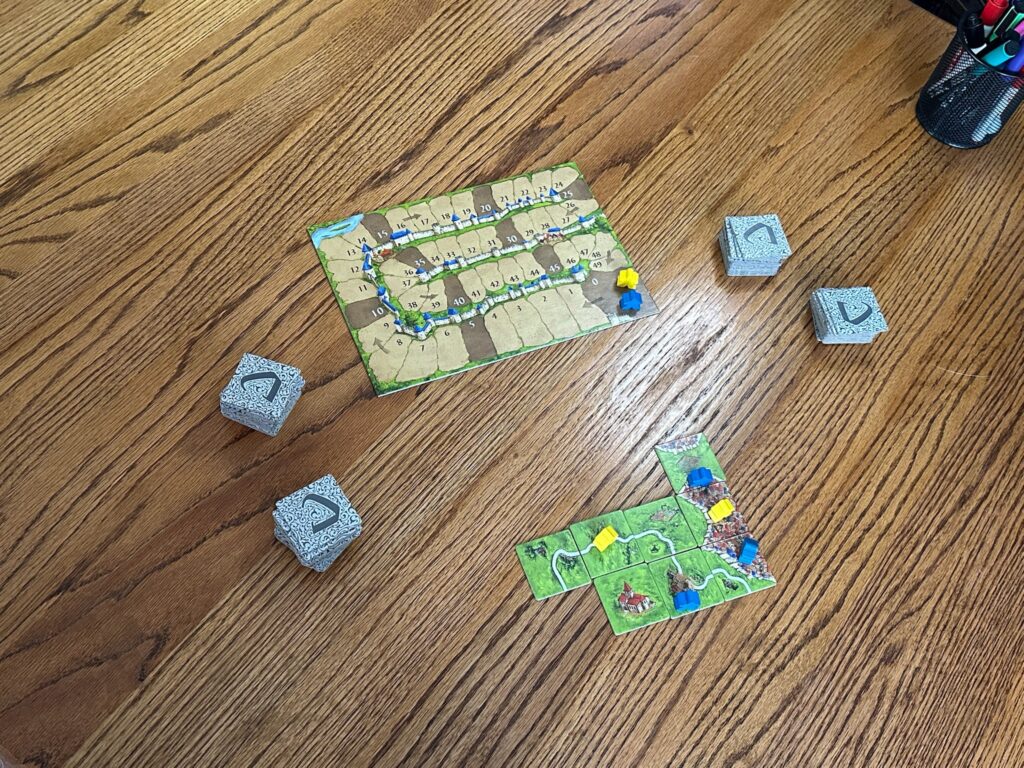
Place the Scoreboard in a central area where all players can see. Put the Starting Tile in the center. Each player puts a Meeple of their color on the 0 space on the Scoreboard and keeps the other 7 in front of them. Shuffle all tiles randomly and place them in upside down stacks where everyone can reach them. You are now ready to play Carcassonne!
*We used the How to Play video on Dized. This allowed us to learn the game turn by turn without having to read the Rule Book.
Gameplay
Gameplay for Carcassonne is straight forward. On a player’s turn they perform the following actions in order: Place a Land Tile, Place a Meeple, and if applicable, Score points. Players pick up a Land Tile and must then play the tile they selected. Players will place the Land Tile by matching a side of it to the side of a Land Tile that has already been previously placed. Players can opt to create larger cities, extend roads, or simply expand the landscape. After a player places a Land Tile, they may choose to place a Meeple on one of the existing features. Players can choose to place a Meeple on part of a city, a segment of road or in a monastery. If a tile cannot be placed, it will be discarded and the player will pick a new tile, though this is a rare occurrence.
Objective
The objective of Carcassonne is to earn the most points. In the Base Game, players earn points by completing cities, completing roads, and surrounding monasteries with tiles. Cities are completed when they are surrounded by a wall on all sides. Roads are completed when they both start and end at a town, or they loop back onto themself. Monastery Meeples earn points once they are surrounded on all sides by other tiles. Each tile of a city earns the player 2 points, and if a tile within a city displays a shield icon, the player will earn an additional 2 points. Each tile of a road scores 1 point. A monastery earns 9 points once it is surrounded by 8 other tiles. As players earn points they move their Meeple on the Scoreboard. Depending on how the tiles are placed, there may be 1 or more Meeples on a feature. If there are Meeples of different colors, whichever player has the most Meeples placed on the feature wins the points. If two or more players have the same number of Meeples on the feature, all players with that number will get the full point total.
Final Thoughts
Carcassonne is an excellent tile placement game that does what it sets out to do very well. The ever changing landscape provides great replayability. I love that the version we played includes the River and Abbot expansions, providing even more content right out of the box. Additionally, there is a supplemental rule set providing scoring rules for fields and farmers. The designers also did a great job providing effective storage within the game box. The game was relaxing, and I loved the details on all of the tiles. Carcassonne is considered a classic for a reason, and it certainly held up to its hype when we played it. It is a great addition to any board game collection!
This post may contain affiliate links. If you click through and make a purchase, we may earn a small commission at no extra cost to you. Some products may have also been gifted for review purposes. We only recommend products we love and believe will add value to your experience. Read more on our Business Conduct Page. Thank you for supporting our blog!